That Noise Isn't Nothing - But It Isn't Always an Emergency Either
A look at why Malibu garage doors grind, pop, or squeal, tied to the area's 1967-1997 housing stock and mild coastal climate, with guidance on when a sound is a repair job.
A lot of owners in this area hear a new sound from the garage and decide it can wait
Sometimes that's the right call. Most houses across Malibu and the nine named areas that make up this service area - Topanga, and the rest - were built between 1967 and 1997, with the median landing around 1979. That means a huge share of the openers, tracks, and springs in these garages are original or close to it, and a door that's been quietly aging for four decades will start to tell you about it before it fails outright.
02
A soft rattle on a door that still opens smooth and stops where it should isn't usually urgent
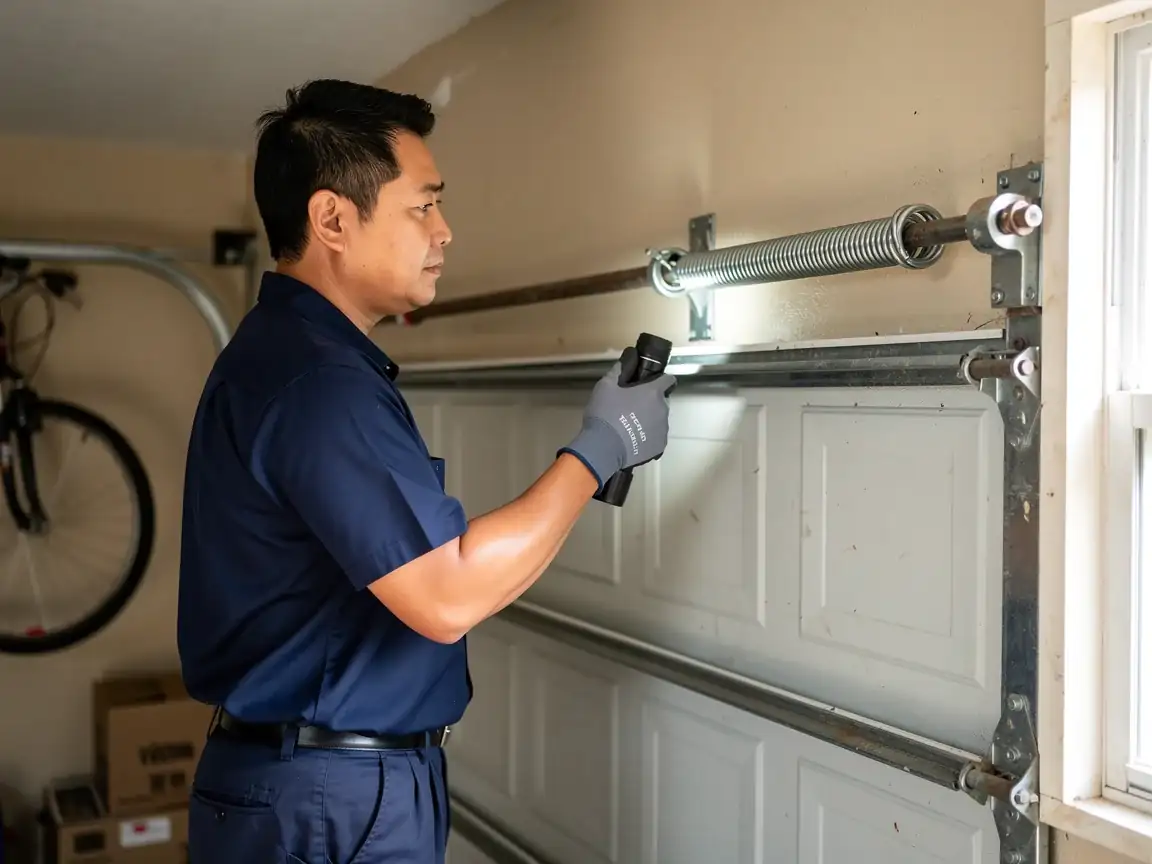
What changes the math is a sound that's new, sudden, or paired with the door hesitating, sagging on one side, or needing a shove to get moving. That combination means something has shifted in the hardware, not just worn evenly. Waiting on that kind of noise doesn't save you a call - it just moves the call to a worse time, usually right when the door won't open at all. The honest limitation here: a noise alone, without a second symptom, isn't enough for anyone to diagnose over the phone. It takes someone looking at the actual spring and track.
What Local Conditions Do
Malibu sits in a mild temperate band, and that matters more for noise than people expect. In places with hard freeze-thaw cycles, metal fatigues and snaps faster, and that's usually the loudest, most dramatic failure. Here, the climate isn't doing that work. What it does instead is slow and steady: salt air near the coast and consistent humidity swings work on fasteners, hinges, and roller bearings over years, not seasons. The result is less a sudden bang and more a progressive dry, grinding sound as lubrication breaks down and metal-on-metal contact increases.
That's a different failure pattern than a lot of national advice assumes, and it's why generic maintenance checklists built for colder climates don't map well onto a Malibu garage. You're less likely to deal with a spring that snapped overnight from cold contraction, and more likely to deal with a roller or hinge that's been quietly losing lubrication for a year and just crossed the threshold into audible. If your door has gone from silent to squealing over a few months rather than a few days, that's consistent with the slow wear this climate produces, not a sudden structural problem.
The Situation
Across the roughly 19,499 households and 9,734 owner-occupied houses in this service area, the garage door fleet skews old by national standards - mostly 1960s-70s stock, per the area's housing profile, with some newer construction mixed in. That age spread means two neighbors on the same street can have very different doors: one running original torsion hardware from the build year, another with a replaced opener from a decade back. The noise that's normal for one can be a warning sign on the other.
Income in this area is well above the national median, at roughly $174,069 households and up, and that tends to show up in how people handle these calls. Most owners here don't try to nurse a forty-year-old opener through one more season - once a noise is confirmed as hardware wear rather than something cosmetic, the usual move is replacement over repeated patch repairs. That's a pattern worth knowing before you decide whether a new sound is worth a service call or worth planning a swap.
When to Get Help
01
Call when the noise shows up alongside a change in how the door moves
Slower, uneven, stopping partway, or reversing on its own. Call immediately if you hear a loud bang followed by the door refusing to lift; that's consistent with a broken spring, and a door in that state shouldn't be forced open by hand or by the opener. A grinding sound on an otherwise smooth-running door is worth a look soon, not necessarily today.
02
If you're further out
Topanga, Lake Sherwood, Oak Park, Hidden Hills, Bell Canyon, Santa Susana, Santa Rosa Valley, or toward Marina del Rey - the same rule applies regardless of distance from the coast: age of the hardware matters more than location within the service area. A door built in the median year, 1979, carries the same risks whether it's a mile from the water in further inland. We don't do every job by phone diagnosis, and we won't guess at a spring problem sight unseen - that one needs eyes on the track.
How it works
From “it’s stuck” to “it’s fixed”
1
Tell us what’s wrong
Describe the symptom - won’t open, loud bang, opener runs but the door won’t move.
2
On-site diagnosis
A technician tests the door under power and by hand and finds what actually failed.
3
Clear, up-front plan
You get the fix that’s needed and what drives the cost - before any work starts.
4
Repaired & tested
The repair is done, the door is set true and tested, and the work area left clean.
Not sure which repair your door needs in Malibu, CA? Describe what it’s doing - every job starts with a diagnosis.
Straight answers about garage door repair in Malibu. Still unsure? Ask us directly.
Why does my garage door squeal only in the morning?
Humidity swings overnight can leave a thin layer of moisture on rollers and hinges that burns off as the day warms. In this mild coastal climate, that daily cycle slowly dries out lubrication faster than owners expect, so a morning squeal that fades by afternoon is usually a lubrication issue, not a structural one.
Is a grinding noise always a spring problem?
No. Grinding more often points to a worn roller or bent track than a spring. A spring failure tends to be a sudden loud bang, not a gradual grind. Given how much of the hardware in this area dates back toward the 1970s, a grind is worth checking before it wears the track further.
Should I just replace the opener instead of fixing the noise?
If the opener is original to a house built in the 1970s or 80s, repair parts are often harder to source than for a newer unit, and a lot of owners in this area choose replacement once the noise is confirmed as hardware wear rather than something minor.